
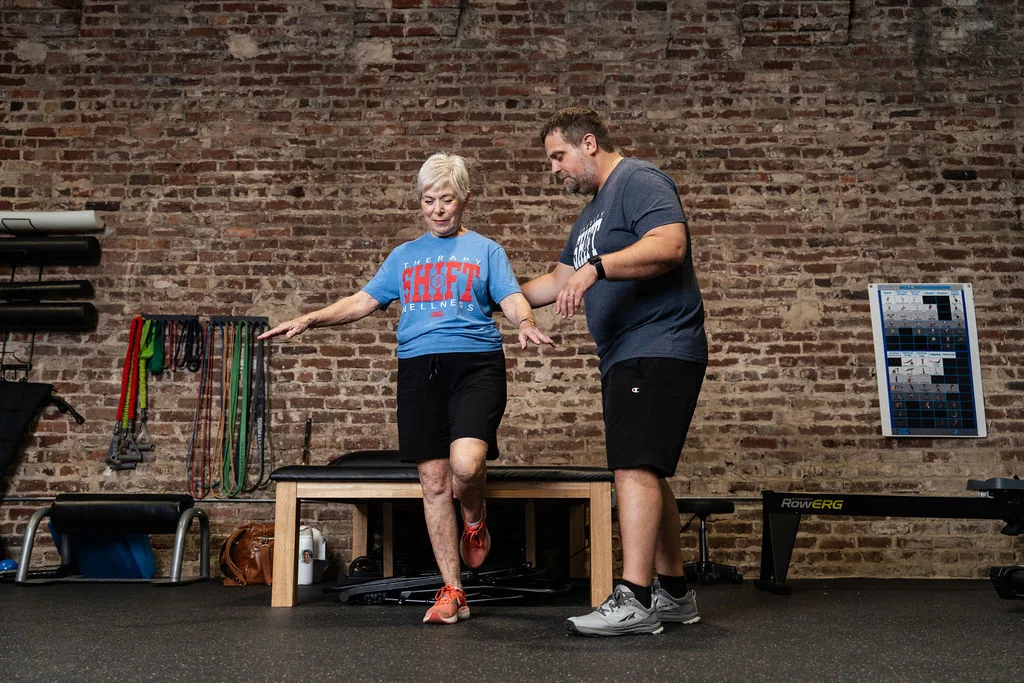
The Systems Behind Your Balance
Whether it's sudden dizziness or a gradual loss of balance, feeling unstable can be scary, but at Shift Therapy, we help patients across Rome find their footing every day. While it's tempting to dismiss unsteadiness as just “getting older” or “having a clumsy day,” persistent balance issues are often your body's way of signaling an underlying issue that needs attention.
Balance isn't just about strong legs, it's an intricate dance between three main sensory systems working together.
When these systems miscommunicate or weaken, that unsteady feeling takes over.
Common Reasons You Feel Unsteady on Your Feet
Vestibular Dysfunction (Inner Ear Issues)
Conditions like Benign Paroxysmal Positional Vertigo (BPPV) occur when tiny calcium crystals in the inner ear become dislodged, causing intense, brief episodes of dizziness when you move your head. Other issues, like labyrinthitis, can also disrupt the signals sent to your brain, leading to vertigo and unsteadiness.
Muscle Weakness and Atrophy
Strong muscles, particularly in your core, hips, and legs, are the pillars that hold you upright. As we age or become less active due to injury or pain, these muscles can weaken. If your glutes or quadriceps aren't strong enough to support your movements, you may feel shaky or unable to catch yourself if you stumble.
Peripheral Neuropathy
Damage to the nerves outside the brain and spinal cord, often affecting the feet and hands, creates numbness or tingling. If you can't physically feel the ground beneath your feet, your brain stops receiving the “ground reaction force” data it needs to adjust your posture.
Medication Side Effects
Many common prescriptions, including blood pressure medications, sedatives, and antidepressants, list dizziness or lightheadedness as side effects. If your unsteadiness started after a new medication, it's worth discussing with your doctor.
Orthostatic Hypotension
Feeling dizzy specifically when you stand up too quickly is often due to a sudden drop in blood pressure, which happens when your cardiovascular system doesn't adjust fast enough to the change in position.
Vision Problems
Since your eyes provide depth perception and spatial context, vision changes can severely impact balance. Outdated prescriptions, cataracts, or glaucoma can distort what you see, making it harder to judge steps or uneven pavement.
Joint Stiffness and Pain
Arthritis or past injuries in the ankles, knees, or hips can restrict your range of motion. When your joints can't move freely, your body compensates by changing your gait, an altered pattern that's often less stable.
How Physical Therapy Restores Stability
The good news is that balance is a skill, and like any skill, it can be improved with practice and the right guidance. At Shift Therapy, we don't just treat the symptom, we look for the root cause.
Vestibular Rehabilitation
For inner ear issues, specific head maneuvers and exercises retrain your brain to process signals from the inner ear correctly, effectively treating symptoms of vertigo and dizziness.
Strengthening & Conditioning
If muscle weakness is the culprit, we design a personalized program targeting the specific muscle groups responsible for stability, focusing on core and lower-body strength.
Gait Training
Sometimes we unknowingly develop bad walking habits to avoid pain. Gait training analyzes how you walk and uses exercises to correct your mechanics.
Proprioceptive Training
Specialized exercises “wake up” the nerve sensors in your joints, like balancing on uneven surfaces or moving with your eyes closed to force your body to rely on its internal sensors.
Taking the First Step Toward Stability
Ignoring unsteadiness often leads to a fear of falling, which can cause you to limit your activities. This creates a vicious cycle: you move less to stay safe, your muscles weaken further from inactivity, and your balance worsens.
You don't have to live with the fear of falling. Whether you are recovering from an injury, managing a chronic condition, or simply noticing that you aren't as agile as you used to be, help is available without a doctor's referral. Georgia is a direct access state, meaning you can come straight to us to start your recovery journey.
Common questions, answered.
01 / Can dehydration cause me to feel unsteady?
02 / Is walking good for improving balance?
03 / How long does it take to improve balance with physical therapy?
04 / Do I need a referral to see a physical therapist for balance issues?
Find Your Balance Today
Unsteadiness doesn't have to define your life. By identifying the reasons you feel unsteady on your feet and addressing them with professional care, you can return to the active lifestyle you love.
Ready to feel better?
No referral needed. Most insurances accepted. Same-week appointments available.
Your first visit is a full, unhurried evaluation with a Doctor of Physical Therapy. Come in, tell us what's going on, and leave with a clear plan.
You’re all set.
We’ll reach out within one business day to confirm your appointment. If you need to speak with us sooner, call us directly.